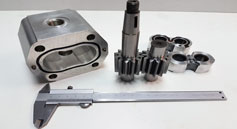
Which cylinder data you need
When a cylinder is already installed but the pump or power pack is missing, selection should begin with the force and speed required by the machine. The calculation below determines the flow needed to extend a double-acting cylinder and the displacement of a pump running at a known speed. It uses the volume on the side without the rod; retraction also requires the rod diameter to be checked.
1. Calculate the piston-side volume
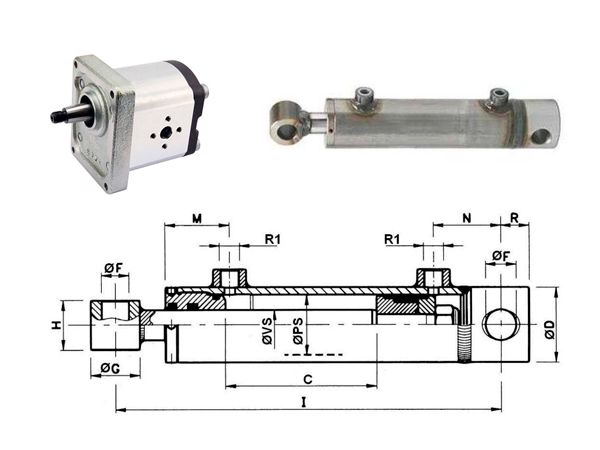
Let D be the cylinder bore or piston diameter in millimetres and C the useful stroke, also in millimetres. Stroke is the difference between the fully extended and fully retracted positions, not the overall external length of the cylinder. The volume to fill during extension is:
V [l] = 0.7854 × D² [mm²] × C [mm] / 1,000,000
2. Determine flow from the travel time
Choose the time t, in seconds, in which the cylinder should complete its stroke. Flow Q is expressed in litres per minute. The chosen time must be compatible with the cylinder’s maximum permitted speed and the machine cycle. Increasing flow to shorten the travel time also requires checks on valve, pipework and actuator limitations.
Q [l/min] = 60 × V [l] / t [s]
3. Convert flow into pump displacement
Displacement Vg is the geometric volume displaced per shaft revolution, expressed in cm³/rev. The calculation needs drive speed n in rpm and volumetric efficiency ηv. In the first formula below, ηv is a fraction: enter 90 % as 0.90. When efficiency is entered as a percentage number, such as 90, use the second expression.
Vg [cm³/rev] = 1,000 × Q [l/min] / (n [rpm] × ηv)
Vg [cm³/rev] = 100,000 × Q [l/min] / (n [rpm] × ηv [%])
Example: 80 mm bore and 600 mm stroke
For D = 80 mm and C = 600 mm, the volume is approximately 3.016 litres. Completing extension in 10 seconds requires around 18.10 l/min. At a pump speed of 1,500 rpm and an assumed volumetric efficiency of 0.90, the calculated displacement is approximately 13.4 cm³/rev. If the volume is rounded to 3.0 litres at the start of a preliminary calculation, the results are 18 l/min and 13.3 cm³/rev. Check the final selection against the manufacturer’s curves and available displacements.
Choosing volumetric efficiency
Volumetric efficiency varies with pressure, viscosity, temperature, pump condition and pump technology. The 80–95 % range and the 90 % value used in the example are calculation references, not guaranteed performance figures for every pump. Use the value applicable to the actual operating point when sizing the equipment.
Check retraction and return flow
In a double-acting cylinder, the effective area on the rod side is smaller than the piston-side area. With the same supply flow, retraction is faster. During retraction, the flow leaving the piston side can also be greater than the pump flow. Size the return line, directional valve and other oil passages for that flow; otherwise pressure losses and heating will increase.
Flow is only part of pump selection
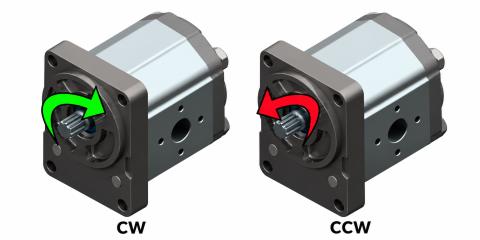
Once displacement has been calculated, check the pressure required by the load, available drive power, running and idle times and machine speed. Select the pump technology—gear, vane or piston—fixed or variable displacement operation, and the mechanical and hydraulic connections. Flange, shaft and rotation must suit the installation. Related guidance is available in pump pressure and flow and hydraulic power.