
A machine can perform well throughout a working day yet experience its greatest hydraulic stresses in the first moments of a freezing morning. Oil that flowed easily the day before is now considerably more viscous; the pump, hoses, filters and actuators have not reached operating temperature either. Immediately increasing speed or demanding maximum force can turn an ordinary start into a failure.
Winter preparation must cover the whole system: fluid, pump supply, drive, materials and the way the circuit is brought into operation. This guide explains what to check and how to make decisions using the equipment’s own data, rather than a temperature or an oil supposedly suitable for every installation.
Which hydraulic machines need special winter preparation?
The issue extends beyond snow-clearing and winter road-maintenance equipment. It affects excavators, loaders, cranes, access platforms, tractors, forestry and agricultural machinery, waste-collection vehicles and port equipment. It also concerns stationary outdoor power packs, compactors, presses, gates and infrastructure-maintenance systems exposed to very low temperatures.
The minimum temperature matters, but so do the length of the shutdown and the surroundings. After standing overnight, the oil, reservoir and pipework can be close to ambient temperature; equipment retaining heat from an earlier shift starts under different conditions. Wind speeds cooling towards ambient, but human wind-chill temperature is not the oil’s actual temperature. Measure at representative locations and consider components far from the reservoir as well.
Why viscosity governs the first start
Viscosity describes a fluid’s resistance to flow. As temperature falls, most hydraulic oils thicken, increasing resistance through lines, fittings and filter elements. In a working circuit this affects pump supply, the torque required to drive the pump and control response. A working-pressure gauge alone cannot show what is happening on the suction side.
A positive-displacement pump must receive enough oil on every revolution. If the inlet line creates excessive resistance, absolute pressure at the inlet can fall outside the manufacturer’s permissible range. Increasing speed then increases the required flow and can make supply conditions worse. Return and case-drain lines are also affected: restrictions can create backpressures that matter for shaft seals and housings.
Cavitation and air ingress are different problems
Cavitation involves the formation and collapse of vapour cavities when local pressure falls sufficiently. Aeration involves free air present in or introduced into the oil; a suction connection that is not airtight is one possible source. Both can cause noise, irregular operation and damage, and they can occur together. Not every whine is proof of cavitation, and increasing speed is not a reliable remedy.
The Parker vane-pump troubleshooting manual lists high viscosity, inlet restrictions, unsuitable pipework, a blocked breather and excessive speed among supply-related problems. The practical lesson is to examine the complete supply path rather than replace the pump alone.
ISO VG, viscosity index and pour point: what each tells you
ISO VG classifies an oil by its nominal kinematic viscosity at 40 °C. It identifies a viscosity grade, but does not directly describe how much the fluid will thicken on a winter morning. Two oils carrying the same grade can behave differently during a cold start.
- Viscosity index, or VI: indicates how viscosity changes with temperature within the scope of the test method. A high VI can help widen the operating window, but cannot replace low-temperature data or establish pump suitability on its own.
- Pour point: is a laboratory result obtained under standardised conditions. Being above that point does not demonstrate that a fluid can supply a pump, pass through a filter or circulate through a particular line adequately.
- Starting and operating viscosity: must be checked against each component’s limits. A maximum viscosity may be permitted only during starting, with accompanying restrictions on speed, pressure or duration.
- Approvals and compatibility: additive chemistry, seal materials, shear stability and environmental requirements also matter. High VI alone is not a reason to disregard them.
The Danfoss hydraulic-fluid guide discusses these properties in relation to hydraulic components. Use the current fluid data sheet and ask the supplier for information at the expected temperature if it is missing. Do not treat different test methods as interchangeable or extrapolate a curve far beyond its documented range.
Check the units as well
Kinematic viscosity is commonly expressed in mm²/s or cSt; dynamic viscosity in mPa·s or cP. Do not compare their numerical values directly: conversion requires the fluid density at the same temperature. The Mobil DTE 10 Excel performance data sheet presents viscosity, viscosity index and pour-point data separately. It is cited to illustrate how to read a data sheet, not as an oil selection for every machine.

Select oil for hot operation as well as cold starting
The aim is to keep viscosity within the system’s permitted window from the coldest start to the hottest operating condition. Choosing a lower grade solely for winter can leave the oil too thin under load once hot: internal leakage may increase and the lubricating film may be reduced. Selection must address both ends.
- Establish the actual minimum oil temperature before starting and the expected maximum in operation, including storage conditions and duty cycle.
- Identify the pump, motors, valves and other critical components by their full references and current technical documents.
- Check viscosity, inlet-pressure and speed limits, distinguishing starting, continuous operation and transient conditions.
- Obtain the relevant viscosity data and approvals from the fluid supplier. Confirm that the required properties remain stable in service.
- Review seal and material compatibility, mixing with the existing fluid, and any necessary changeover or flushing procedure.
- Validate the solution in the installation: temperature, inlet conditions, filter behaviour and a controlled start.
Limits cannot be transferred between pumps. For example, the Danfoss Series 40 technical information distinguishes operating conditions from cold-start exceptions. Its values must not be applied indiscriminately to a gear pump, vane pump or another transmission.
Pump suction: a critical part that is easily overlooked
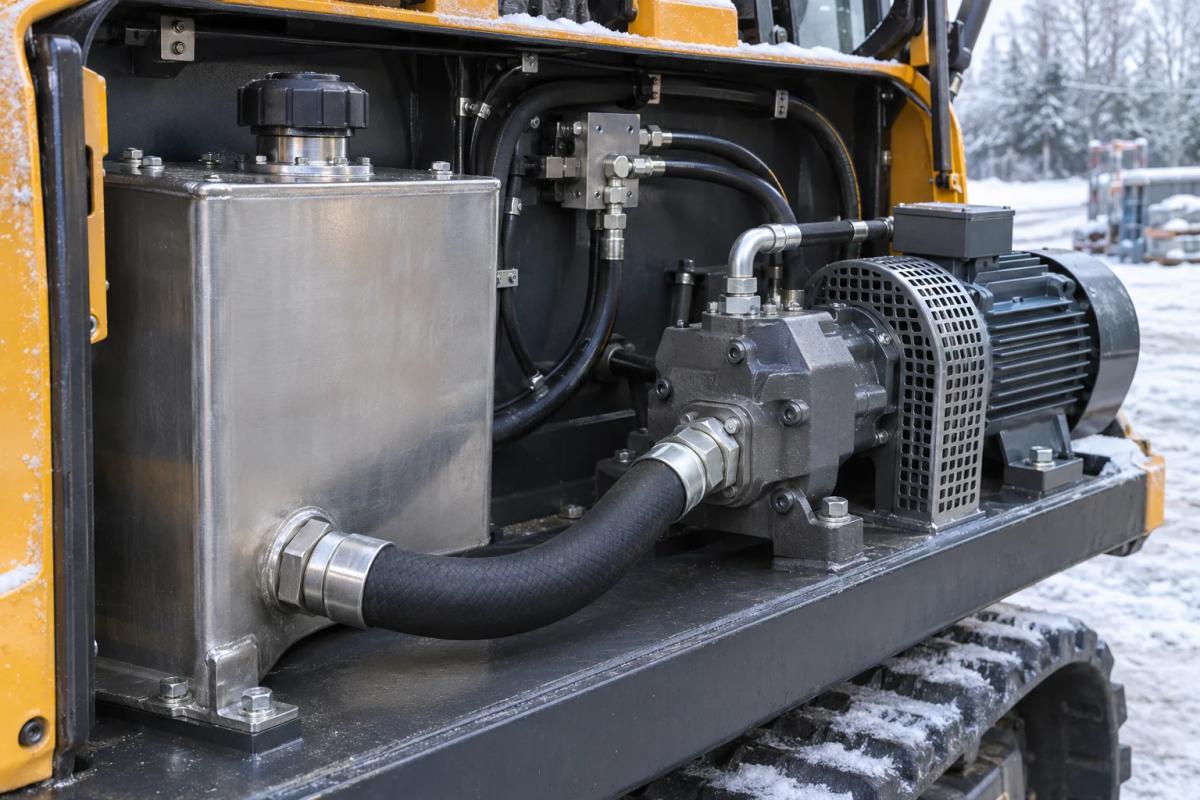
A suction line must be sized using actual flow, viscosity and inlet conditions. Internal diameter, length, elevation, bends, fittings and any other restriction all matter. A hose that looks large can have a reduced bore at its fittings; it can also deform if it is unsuitable for the working vacuum.
A short, well-designed route generally helps supply, but is not permission to remove components specified by the manufacturer. Check oil level, inlet positions, required submergence, airtightness and freedom from obstruction. Inspect the reservoir breather too: inadequate air admission as the oil level changes can affect pump supply.
Where diagnosis calls for it, measure inlet pressure at the point and with the instrument specified by the manufacturer. Distinguish absolute pressure from gauge-pressure or vacuum readings and consider working altitude. A pressure gauge on the outlet does not replace this check.
The reservoir-to-pump supply arrangement described here mainly concerns open circuits. Closed-loop hydrostatic transmissions also require checks of the charge or replenishing circuit, its pressure, filters, cooling and drains according to the manufacturer; do not assume that the main pump draws directly from the reservoir.
Filters, drains and valves also respond to cold
Filter pressure drop rises when more viscous oil passes through it. Selecting by nominal flow or connection size alone is therefore insufficient. Assess the housing, element, starting and operating viscosity, indicators and any bypass valve. HYDAC explains these filter-sizing considerations in its technical guidance.
A clogging indication during a cold start does not automatically prove that the element is dirty: viscosity may contribute. Nor should the indication be ignored without checking the indicator’s instructions and the system’s condition. Do not remove the element, alter the bypass setting or increase pressure to conceal a symptom. Suction filters deserve particular attention because they affect pump inlet conditions.
Check permissible return and case-drain backpressure. Cold oil can alter the response and internal losses of proportional valves and controls; do not compensate for temporary behaviour with permanent adjustments before investigating temperature and fluid conditions.
Electric drives, batteries and combustion engines
In an electrohydraulic power pack, more viscous oil can demand greater starting torque and more torque to circulate the fluid. Current, its duration and voltage drop must be evaluated for the particular motor and starting system. A cold lead-acid battery generally delivers less starting power; state of charge and ageing also affect it. The Interstate battery guide describes this relationship with cold. Behaviour must be checked for the particular technology and system.
Check the battery, terminals, earth connections, cable size and length, contactor and protection devices against the system specification. If voltage falls or the motor struggles to turn, repeated prolonged starts can overload components. Lithium-battery management systems may restrict charging or discharge in the cold: follow the battery manufacturer’s instructions.
With an engine-driven machine, avoid immediately demanding a high hydraulic flow as well. Starting the combustion engine or warming its coolant does not mean that the hydraulic oil and outdoor actuators are ready for full load.
Hoses, seals, water and system heating
Check the minimum permitted temperature of hoses, shaft seals, other seals, accumulators, sensors and fittings. A hose suitable for a certain pressure at normal temperature is not automatically approved to operate or flex in severe cold. Avoid impacts, forced bending and abrupt movements until the conditions of use have been established.
An elastomer family alone does not guarantee performance either: compound formulation and seal design matter. The Parker sealing-technology documentation distinguishes options for different thermal conditions. A solution advertised for high temperatures must not be assumed suitable for severe cold.
Water can enter through condensation, reservoir breathing, servicing or external contamination. It promotes corrosion and lubrication problems; at sufficiently low temperatures it can form ice and obstruct passages. Visual inspection cannot replace fluid analysis when contamination is suspected. Keep filling points clean and apply the installation’s specified moisture-control measures.
If preheating is required, use equipment designed for the reservoir, fluid and surroundings, with appropriate controls. Heating one area does not establish that the whole circuit is at the same temperature. Do not use flames or improvised electrical heaters, or prolonged operation against a relief valve as a generic warming method.
Do not dilute oil with diesel fuel, kerosene or improvised additives to improve circulation. The Parker C101 pump service documentation warns against this practice and provides for progressive warming. The procedure for your own machine remains the applicable reference.
A preparation and progressive-start sequence
- Before energising: establish that oil and temperature meet the authorised starting conditions. Check level, leaks, hoses, breather, filters and drive condition.
- Prepare the machine: secure the area, stabilise loads and set controls and unloading circuits as directed by the manual. A lever position does not guarantee unloading on every system.
- Preheat when needed: follow the manufacturer’s arrangement and designated check points.
- Start within the permitted conditions: use the specified initial speed and demand. Listen to the pump and observe supply, voltage or current where relevant.
- Circulate and test progressively: make controlled movements without unnecessary load where the manufacturer permits. Warm reservoir oil does not immediately warm cylinders and remote lines.
- Enter normal service only when criteria are met: temperature, viscosity, indicators and behaviour must allow it. There is no universal warm-up time.
- Stop and investigate abnormalities: severe noise, foam, jerky movement, leaks, excessively low voltage or persistent warnings are not a normal stage to force the machine through.
Idling the engine or leaving controls in neutral does not guarantee useful circulation to warm the whole system. With variable-displacement pumps or closed-centre circuits, follow the manufacturer’s intended warm-up flow path and check its criteria before applying load.
Quick diagnosis: symptoms and useful checks
| Symptom | Possible causes | What to check |
|---|---|---|
| Loud noise at start-up | Inadequate supply, air, excessive oil viscosity | Temperature, airtightness, inlet pressure and permitted speed |
| Slow electric motor or protection trip | High torque demand, voltage drop or electrical fault | Battery, terminals, cables and current according to the manual |
| Filter indication in cold conditions | Viscosity-related pressure drop or contaminated element | Indicator operating conditions, viscosity and differential pressure |
| Slow or irregular actuators | Pressure losses, air or altered control response | Circuit temperature, flow and valve conditions |
| Foam in the reservoir | Aeration, unsuitable return arrangement or contamination | Level, inlet connections, return and fluid condition |
| Leaks after a freezing start | Incompatible seals, hardened material or excessive backpressure | Material temperature ratings and return/case-drain limits |
Symptoms guide investigation; they do not identify a failed part on their own. If work requires opening the circuit or intervening on components, follow the machine’s isolation and depressurisation procedure, including stored energy. Never search for a pressurised leak with your hand.
Tomorrow’s preparation starts when parking
At the end of the shift, park the machine and secure loads as directed by its manual. Investigate abnormalities before they recur in the cold, keep filling points protected and plan authorised preheating if it will be needed. Record temperature, warnings and starting conditions: comparing days helps identify changes. A prolonged shutdown cools the circuit again, even if the oil was warm when parked.
Information needed to plan a winter solution
A technical enquiry is more useful with pump and drive references, a schematic, the current oil and data sheet, starting and operating temperatures, initial speed, flow, suction-line length and internal diameter, fittings, filters and breather details. Add available inlet, return or drain measurements, altitude and a description of the symptom. For electric power packs, include voltage, battery chemistry and motor data.
This information makes it possible to assess a suitable fluid, a suction modification, cold-compatible filtration or preheating. Replacing one part without examining the system can simply move the problem to another component.
Frequently asked questions about hydraulics in severe cold
Is a very low pour point enough?
No. The fluid must also meet starting and operating viscosity limits, inlet conditions and equipment approvals. Pour point is not an authorised minimum operating temperature.
Does thinner oil always solve starting problems?
It may circulate more easily when cold yet be unsuitable when hot or incompatible with the system. Selection must cover the complete operating window, not just the first minute.
Can I warm the circuit by running the pump faster?
Only within the manufacturer’s procedure and limits. When supply is inadequate, raising speed increases inlet demand and can worsen the problem.
How long should the machine warm up?
There is no time suitable for every machine. Fluid, temperatures, volume, load and design all matter; use the equipment’s measurable service-readiness criteria.
Why does it work well after warming up but poorly in the morning?
The viscosity change can expose restrictive suction, an incorrectly sized filter, inlet air or an inadequate drive. A disappearing symptom does not remove its cause.
Does this preparation also apply to a fixed outdoor power pack?
Yes. Fluid, pump supply, materials, filtration and starting method still need checking. Being stationary does not prevent cooling during a long shutdown.
Related guides to support your checks
- Installing and starting hydraulic gear pumps
- Pump cavitation: causes and prevention
- Hydraulic oil and viscosity selection
Technical documentation consulted
- Danfoss: hydraulic fluids and lubricants
- Danfoss Series 40: technical information
- Parker: vane-pump service manual
- HYDAC: filter-selection criteria
- Mobil DTE 10 Excel: performance profile
- Parker: cylinder sealing technology
- Interstate: battery technical guide
- Parker C101: pump service manual
Hidraoil Fluid Power: to identify a pump or assess a winter application, provide its reference and the circuit’s actual conditions. Responsible selection starts with those details and the manufacturer’s documentation.